Babe Lake
Ba Be is Vietnam’s largest natural lake and is now the centrepiece of an extensive babeNational Park. The park and the surrounding area is limestone country, so lakes, waterfalls, caves and unusual rock formations abound.
Ba Be is Vietnam’s largest natural lake and is now the centrepiece of an extensive babeNational Park. The park and the surrounding area is limestone country, so lakes, waterfalls, caves and unusual rock formations abound. The whole area is richly forested and home to many ethnic minority communities.
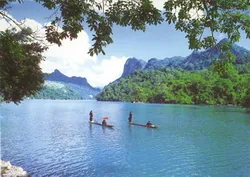 Ba Be lakes (three lakes) is on the height of 145 meters above the sea level, it is composed of 3 smaller lakes linked together, Ba Be is the biggest natural lakes in Vietnam. The lake is 8 km long, 3 km wide and 20-30 meters deep with a total area of more than 500 ha. It is located among a vast range of limestone mountains and surrounded by dense jungles. Around the lakes are caves and grottoes of all sizes, underground streams and waterfalls.
As an eco tourism site, Ba Be lakes is amongst the complex of Ba Be National Park with 21 attractive points such as Bat Cave, Puong Grotto, Fairy Pond, Dau Dang waterfall and the Nang river which ferry tourists from the town of Cho Ra district, Bac Can town to the center of the lakes. If travelling on the path along the rivers, tourists would be surprised to see children playing with wild pigs, these pigs are caught by local people from the forest when they are small.
With an area of 23.000 hectares, National Park Ba Be is a precious natural heritage. This is a system of primary forest on limestone mountains, surrounded the blue lake. Here there are 417 plant species and 299 animal species with a spine. There are many kinds of rare animals like land phoenix, wild chicken, monkeys of all kinds.
Dau Dang waterfall is the meeting point between Nang river and Tuyen Quang province. The fall is about 2 km long, it is where the river is blocked by rocks of all sizes overlapping each other over a slope of 500 meters, forming a spectacular waterfall, here also appears Chien fish, some weigh over 10 kg, which is very rare today.
Ao Tien (Fairy Pond) is a small lake, up about 3 hectares is located on top of the mountain. Being surrounded by tropical forests, climate here is very cool and fresh. Legend has it that this is where fairies from heaven would come bathing and playing chess
Puong Grotto is on the Nang river, it was formed by water coming through a limestone mountain. The grotto is 200 meters long with an average height of 25-30 m with a variety of stalagmites and stalagtites of all shapes. the cave is home to hundreds of thousands of bat. The cave is really a particularly unique and attractive point.
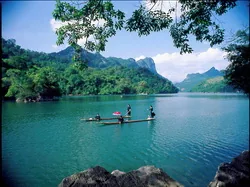 Pac Ngoi village of the Tay minority group lies on the side of the lake, it is a small village of around 60 families who live on rice corn cultivation. The stilt houses are beautifully located on the hill sides. Tourists to this area all take a boat trip to visit the lakes, enjoy spectacular scenery of islands among the wild nature.
* The limestone ‘karst’ scenery is attractive, unspoilt and fich in bio-diversity. Few visitors venture further north than Ba Be, so Cao Bang vies with the remote northwest as one of the best places to see truly authentic ethnic minority lifestyles.
* From Cao Bang, it’s possible to loop round to the south via the border town of Lang Son to Quang Ninh Province and Ha Long Bay. However, the road is poor, and the scenery is not particularly interesting
Ba Be can only be reached by road - the 250km journey takes between six and eight hours. The road gets rough along the latter part, but the excellent scenery compensates. An interesting stop en-route is Thai Nguyen, a centre of heavy industry based on steel manufacturing, and the unlikely home of the Museum of Nationalities of Vietnam. It provides an informative overview of the country’s many ethnic minorities, particularly useful for visitors that haven't already visited Hanoi's excellent Ethnology Museum
As an eco tourism site, Ba Be lakes is amongst the complex of Ba Be National Park with 21 attractive points such as Bat Cave, Puong Grotto, Fairy Pond, Dau Dang waterfall and the Nang river which ferry tourists from the town of Cho Ra district, Bac Can town to the center of the lakes. If travelling on the path along the rivers, tourists would be surprised to see children playing with wild pigs, these pigs are caught by local people from the forest when they are small.
With an area of 23.000 hectares, National Park Ba Be is a precious natural heritage. This is a system of primary forest on limestone mountains, surrounded the blue lake. Here there are 417 plant species and 299 animal species with a spine. There are many kinds of rare animals like land phoenix, wild chicken, monkeys of all kinds.
Dau Dang waterfall is the meeting point between Nang river and Tuyen Quang province. The fall is about 2 km long, it is where the river is blocked by rocks of all sizes overlapping each other over a slope of 500 meters, forming a spectacular waterfall, here also appears Chien fish, some weigh over 10 kg, which is very rare today.
Ao Tien (Fairy Pond) is a small lake, up about 3 hectares is located on top of the mountain. Being surrounded by tropical forests, climate here is very cool and fresh. Legend has it that this is where fairies from heaven would come bathing and playing chess
Puong Grotto is on the Nang river, it was formed by water coming through a limestone mountain. The grotto is 200 meters long with an average height of 25-30 m with a variety of stalagmites and stalagtites of all shapes. the cave is home to hundreds of thousands of bat. The cave is really a particularly unique and attractive point.
* The limestone ‘karst’ scenery is attractive, unspoilt and fich in bio-diversity. Few visitors venture further north than Ba Be, so Cao Bang vies with the remote northwest as one of the best places to see truly authentic ethnic minority lifestyles.
* From Cao Bang, it’s possible to loop round to the south via the border town of Lang Son to Quang Ninh Province and Ha Long Bay. However, the road is poor, and the scenery is not particularly interesting
Ba Be can only be reached by road - the 250km journey takes between six and eight hours. The road gets rough along the latter part, but the excellent scenery compensates. An interesting stop en-route is Thai Nguyen, a centre of heavy industry based on steel manufacturing, and the unlikely home of the Museum of Nationalities of Vietnam. It provides an informative overview of the country’s many ethnic minorities, particularly useful for visitors that haven't already visited Hanoi's excellent Ethnology Museum
Source: vietnamtoursbn